Washouts & FSMA compliance
Reefer washouts between loads are standard, not optional. Under FSMA we document previous cargoes and cleaning, so a fish load never cross-contaminates a dairy load.
 United States United States
  Canada
Industries · Food & Beverage
Roughly 20% of temperature-sensitive goods are damaged in transit. For food shippers that is not a statistic — it is a load of Ontario strawberries that arrives at 45 °F instead of 33 °F and gets rejected at the receiver’s dock. "We think it stayed cold" is not an answer; a continuous temperature record is.
Cross-border food freight faces a double challenge. The cold chain has to hold from pickup to delivery — through loading, transit, a border crossing that can add 30 to 90 minutes, and a receiver who will check the temp log before accepting the load. And the documentation has to be perfect: CFIA on the Canadian side, FDA on the US side, USMCA certificates for duty treatment. A temperature excursion during a border delay creates a liability chain from shipper to carrier to receiver to consumer — and the carrier in the middle either prevents it or causes it.
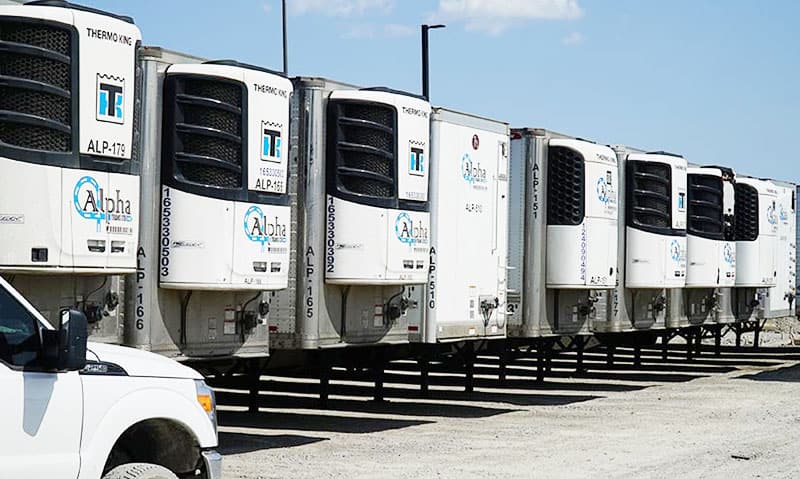
Food & Beverage
Capabilities
Reefer washouts between loads are standard, not optional. Under FSMA we document previous cargoes and cleaning, so a fish load never cross-contaminates a dairy load.
Drivers know pre-cool from cycle-sentry mode and know when to reject a load at origin because the product temperature is already compromised — food safety is the job, not an afterthought.
Every reefer logs temperature automatically every few minutes from pickup to proof of delivery. The result is a continuous, auditable record you can hand to a receiver at the dock or use for a regulatory audit — not a periodic, driver-reported reading.
Fresh produce and dairy (strict 33–40 °F), deep-frozen foods at −20 °F such as ice cream and seafood, beverages and confections including craft beer, wine and chocolate, and meat and protein with USDA/CFIA coordination and full chain-of-custody documentation.
Yes. We are CFIA (Canada) and FDA (US) compliant, our drivers are trained in cold-chain protocols, and reefer washouts between loads — documented under FSMA — are standard practice.
Multi-temp bulkhead trailers let us carry frozen and chilled product on the same truck, which is useful for consolidated grocery and specialty-food shipments.
The reefer holds setpoint through the wait, continuous logging proves it, and dispatch is alerted if anything drifts. As a CT-PAT and FAST carrier we also use the trusted-trader lane to keep border time — and the risk to the cold chain — as low as possible.
Ready when you are
No hold music, no call tree, no broker passing you along — a dispatcher who knows our fleet, our lanes, and your load.
Request a quoteor call (905) 799-1525 · toll-free 1-888-559-0010